
The Path America Chose
Buckle up. This will only get worse before it gets better.

It happened again. Donald Trump was elected president for a second non-consecutive term.
What can we expect this time around? On a systemic level, it portends an exacerbation of all the imbalances that got us here. I’ve illustrated this in my updated flow chart on the crisis cycles of capitalism:
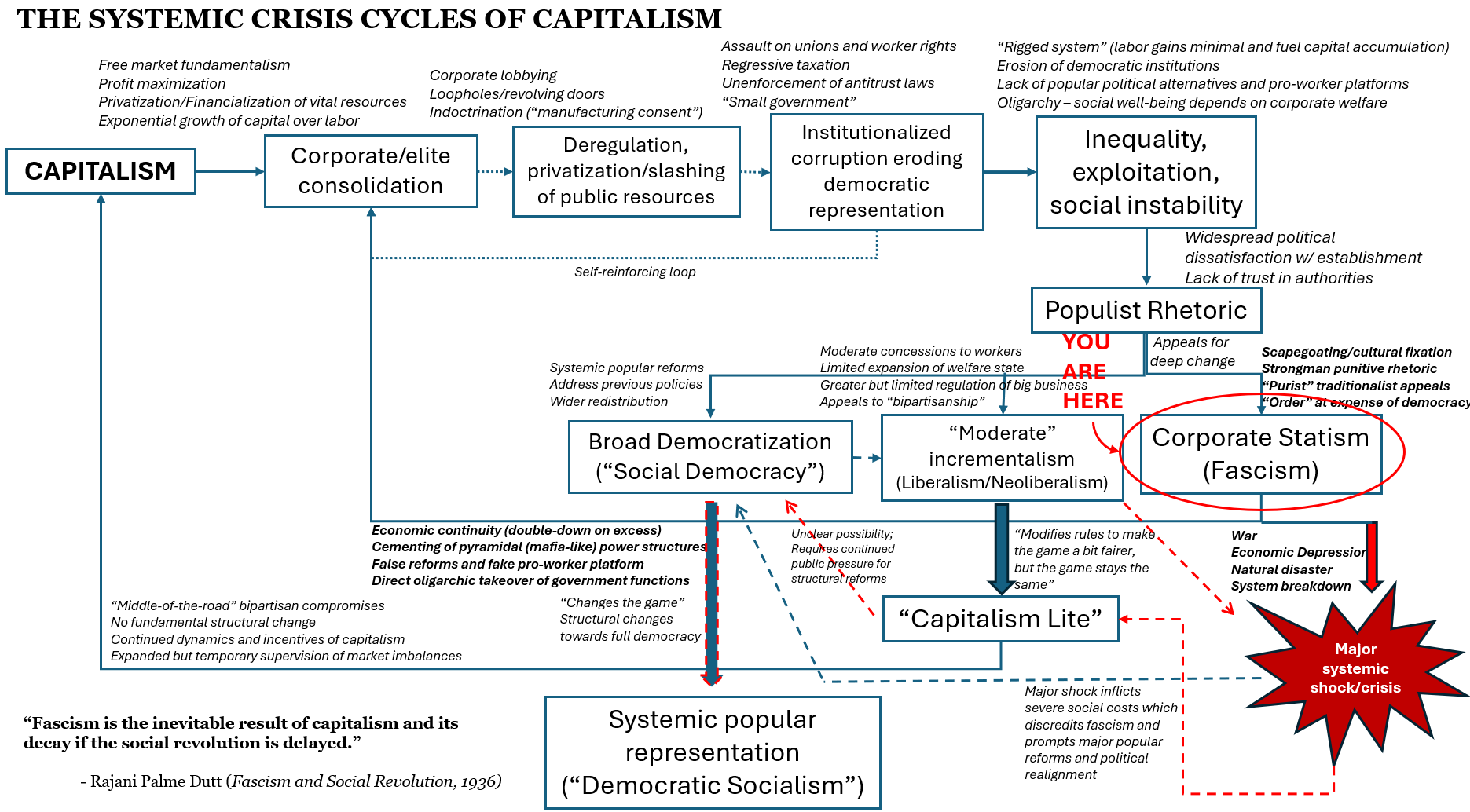
With no real political alternative to correct the gross imbalances of the system we live in and a hostile takeover by America’s oligarchy coming to fruition, every aspect of life that enraged and frustrated Americans stands to get significantly worse very quickly. If you read my previous post about the parallels of history and the New Roaring 20s, it appears we have jumped straight from Woodrow Wilson to Herbert Hoover. Perhaps due to the quicker flow of information, history appears to be fulfilling cycles at a much faster pace. And much like Hoover, who scapegoated Mexicans for economic woes, stacked his administration with oligarchs, and doubled down on deregulation, regressive taxation, and laissez faire economic policy, while withholding government intervention, Trump and his cronies are recreating the conditions that plunged the U.S. into the Great Depression in 1929.
The Election
Before we look to the future, let’s address what I think are the most salient factors that determined this election.
The graph below shows total popular votes for each Party since 2000 (2024 total vote differences have since changed to what is shown in the NYT graphic, but the conclusion is the same):
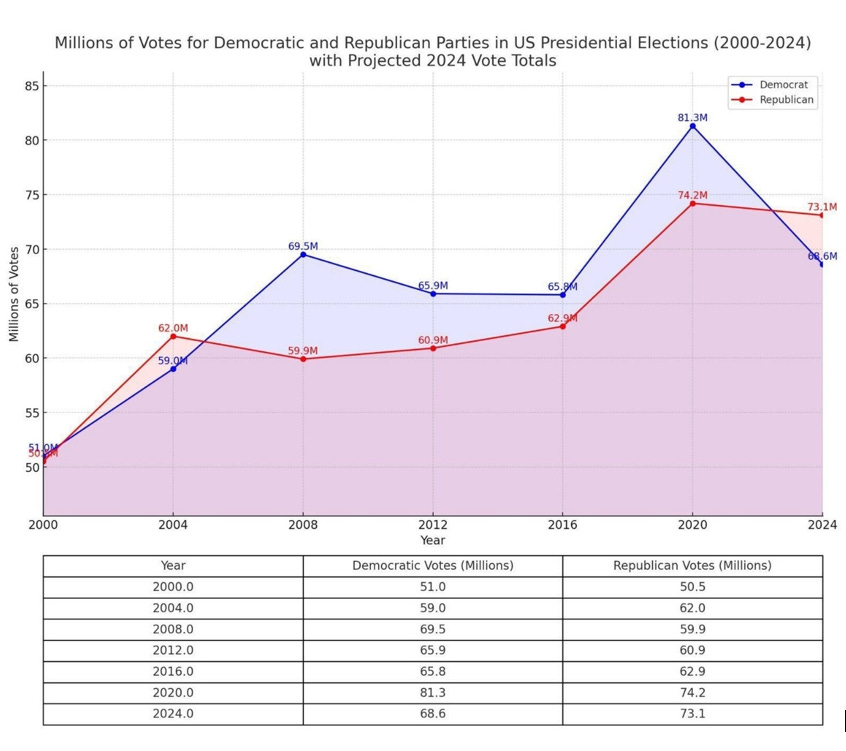
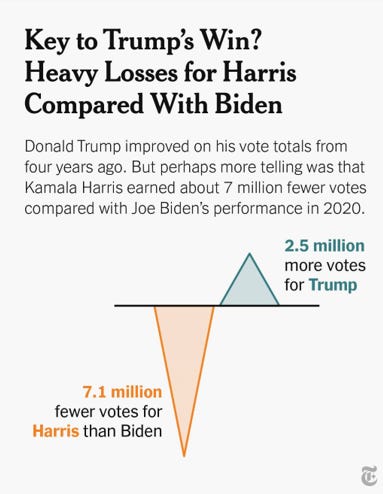
There are two takeaways here. First, though Trump’s voting base did increase, Democrats’ votes took a nosedive. In other words, this wasn’t as much a Trump victory as it was a Democratic defeat. Yes, Donald Trump made inroads with certain demographics, but the reality is that while Trump raised his vote by 2.5M compared to 2020, Democrats’ votes decreased by a whopping 7.1M. Second, both times since 2000 that Democrats’ have drastically increased their voting base have been immediately following a big systemic crisis – the 2008 financial crisis and 2020 pandemic. In both cases, Democrats did a reasonable job in stabilizing a crisis enabled and exacerbated by their GOP predecessors, but a bad job in pushing for deeper changes to prevent it from happening again. The incremental approach now shows its significant limitations.
So why did voters abandon the Democratic Party?
This was not just a stinging rebuke of Joe Biden’s administration, but of the entire neoliberal platform of the Democratic establishment, which has dominated for roughly 50 years since Jimmy Carter. Jimmy Carter, who would narrowly beat Gerald Ford in 1976, swept into office as a moderate Democrat; he was, in fact, a fiscal conservative and deficit hawk, and one of the biggest deregulators of his time. In his first State of the Union, President Carter said, “Government cannot solve our problems, it can’t set our goals, it cannot define our vision. Government cannot eliminate poverty or provide a bountiful economy or reduce inflation or save our cities or cure illiteracy or provide energy.”[1] This paved the way for neoliberalism and Reaganomics, a mode of politics that was further entrenched in the Democratic Party by Clinton and has persisted to this day.
Ever since that pivot, the Democrats have been seen as far too timid and ineffective in addressing working-class Americans’ economic pain, and far too lax in fighting back against the oligarchy that is intent on suppressing labor rights and limiting democracy. Exit polls consistently showed that the issue most voters were concerned about was the economy and democracy. So, it wasn’t just the problems with the Harris campaign. It’s what Biden could have done and did not do throughout the four crucial years voters chose him over Trump – two of those with majorities in the Senate and the House.
Now, we can trace glaring weaknesses with the Democratic Party’s platform as far back as 2016, but let’s leave it at 2020. The Democratic establishment clipped the wings off the rising progressive movement and suppressed a very popular candidate in Bernie Sanders in favor of a much less exciting, establishment-approved, centrist Biden. In the end, Biden eked out a tight victory in 2020 not because of his stellar platform, but because of Donald Trump’s divisiveness and mismanagement of the pandemic. However, those who voted for Democrats in 2020 did not just want to move away from Trump, they also wanted change. It was then up to Biden to deliver it, but as a compromise candidate, he was never going to push hard for the deep popular reforms that progressives were demanding. At some point during his campaign, he told some rich donors that nothing would fundamentally change, and he largely kept that promise.
However, thanks to the push from Bernie and the progressive Left, Biden enacted some surprisingly good policies, especially with regards to worker protections (PRO Act) and continued relief from the pandemic. But two issues dampened that progress: 1) Democrats did a horrible job at promoting these gains (probably because they feared what it would signal to their rich donors), and 2) many hugely popular and effective relief programs, like the Child Tax Credit or eviction bans, were simply allowed to lapse while inflation remained high. Everyone in America felt that sudden drop.
And to be fair, for the first time in history, every governing party facing election in a developed country in the world lost vote-share this year. This signals that the problem was and is systemic and is closely tied to post-pandemic economic grievances, like inflation. But it was not a forgone conclusion that the Democrats would have shared the same fate if they had mitigated those issues as they did at the beginning of Biden’s administration. Biden’s approval after passing the American Rescue Plan was 57%; that dropped to 43% once most pandemic aid programs expired, and then down to 37% once all aid programs expired. It never really picked back up after that.
The Democrats’ agenda was initially more ambitious, but Biden never really used the bully pulpit of the presidency to pressure conservative Democrats, like Joe Manchin or Krysten Sinema, towards bolder policies. At one point in 2021, when the Senate parliamentarian nixed a Democratic push to raise federal minimum wage to $15 per hour, the White House decided to respect the ruling even though it could have simply ignored and overruled it through Vice President Harris. Yet another signal that Democrats were prioritizing, or perhaps hiding behind, rules and formalities over enacting vital popular programs to improve people’s lives.
Finally, and most importantly, Biden made two critical mistakes that cost everyone dearly and essentially cancelled out his progress: 1) he supported the Israeli far-right regime unconditionally as it carried out a massacre in Gaza and inched us closer to a global war, and 2) despite his obvious decline and low approval, he refused to step down as 2024 candidate and allow a Democratic primary to take place. A primary could have field-tested the Democrats’ platform and yielded a democratically-elected candidate that could start fresh and separate themselves from Biden. Instead, he hastily hand-picked his VP, Kamala Harris, with only a few months to go, and her campaign really struggled to dissociate her from a very unpopular Biden administration.
Kamala’s Run
Despite the uphill battle, Kamala ran a decent campaign. Her best moment was when she nominated Tim Walz as her running mate, bucking the establishment’s conventional wisdom that was vying hard for centrist Pennsylvania governor Josh Shapiro. Walz was able to capture some of the Bernie magic with his dad-like energy and everyday-man appeal. He was popular in his state not just because of his flair, but because of his results as a progressive in Minnesota. The polls started to show a real Kamala rise, showing her as much as 7 points ahead of Trump nationally.
But then, with her campaign overrun with the typical establishment consultants and their traditional DC playbook, Walz was set aside and relegated, and the campaign toned down the combative rhetoric altogether. Instead of riding the wave of enthusiasm and honing the progressive platform that had them on the rise, Harris decided to do what Hillary and Biden did: she embraced the right in order to capture a mythical middle. In doing so, she lost ideological consistency and fractured the enthusiastic base that was beginning to coalesce around her.
The shift was obvious. Instead of focusing on progressive populism and workers’ rights, she campaigned with conservative warmongers Liz and Dick Cheney, billionaire Mark Cuban, establishment figureheads the Clintons, and other Hollywood celebrities – all aspects that Trump capitalized on as he positioned himself as the true pro-worker, anti-establishment figure. On policy, she went with a tough-on-borders and tough-on-crime message. She refused to include a Palestinian voice in the Democratic National Convention and could never come up with a convincing response over how to deal with Israel’s escalation. When asked how she was different from Biden on The View, she could not come up with a compelling answer. Her narrative got muddled, soft, and contradictory, and even the theme of the “campaign of joy” started to fall flat when so many Americans, especially working-class ones, were feeling frustrated and angry. Instead, that joy came off as toxic positivity and those policies came off as Republican Lite.
To conservative media’s delight, pundits like Fareed Zakaria are already blaming “woke-ism” and “soft on the border” and “political correctness” and “the Far Left” for Democrats’ defeat. Never mind that the Harris campaign steered clear of all of these themes and in some cases even moved in the opposite direction. These cultural issues were the fixation of Trump voters, not Democrats. According to polls, of issues considered “very important” by all voters, the economy came in 1st and healthcare in 2nd. Immigration didn’t even crack the top 5.
In any case, Democrats’ social progressivism was never the problem. The fact that it did not come with economic progressivism was. History has shown us that social progressivism must be preceded by or at least accompanied by economic progressivism to be sustained. Otherwise, not only does it come off as a hypocritical virtue signaling, but it makes it easier for conservatives to sell the false narrative that the reason for working-class people’s social decline is because of cultural shifts enabled by liberal elites, rather than the real economic corruption by corporate elites. Amazingly, the message some liberal pundits took from this defeat wasn’t “we need to incorporate economic progressivism to back up our social progressivism”, but “we need to move away from social progressivism too” That platform already exists, and it is called conservatism.
The simple lesson that many “moderates” or “centrists” refuse to learn is that Democrats cannot compete with Republicans by being Republican lite. For that, voters already have the Republican Party. In fact, a study from a few years ago on European electoral and polling data found that “adopting right-wing policies on issues such as immigration and the economy does not help center-left parties win votes.” Additionally, it states, “the evidence clearly shows they overestimate the electoral relevance of traditional, white working-class voters and underestimate how strongly their current middle-class voters care about immigrants being treated decently and equally.” And that also played out for Harris: according to an NBC news assessment, in 2020, 14% of self-identified conservatives and 5% of Republicans said they voted for Biden; this year, 9% of conservatives and 4% of Republicans said they voted for Harris. So much for appealing to the middle.
Trump stoked division among regular Americans based on race, religion, legal status, political leanings, cultural norms, and whatever else you can think of. He ran a terrible campaign and yet, his base remained loyal, and he even gained a few followers. Whatever anyone can hold against Trump, his campaign is thematically consistent, even if his actions are not. His emotions are the same: angry and vengeful. His villains are the same: immigrants, “liberal elites”, sexual minorities. His goal, imaginary as it may be, is the same: MAGA. His narrative is the same: “I am your retribution”. He promotes fear of the imaginary or the innocent, stokes anger, and then justifies and embodies it.
This rhetoric cannot work for Democrats. Instead of pushing for bold and brave against the very elites that Trump represents, they took his bait and played into fear: with the border, with crime, with social spending, with the voting bloc hedging, even with Trump himself. Republicans are the party of conservatism; they can afford to hold these reactionary stances and appeal to people’s fear of uncertainty and change. If nothing changes, they win; they’re conservatives. Trump’s goal is ultimately the entrenchment and continuity of a system that rewards him and his cronies immensely, with little regard for what happens to ordinary Americans.
Democrats do not have that luxury. Especially at a time when middle and lower classes are feeling squeezed, their platform must be about proactive change, economic reform, and social progress. When Alexandria Ocasio Cortez asked voters who voted for her and Donald Trump, most of them responded that they felt they both were genuine and represented the working class. The same logic applied for voters who went from Bernie Sanders to Donald Trump. Both acknowledged and spoke to a very real decline being felt by the average American and legitimized their anger over a genuinely rigged system. However, where Trump directed it towards his usual scapegoats, Bernie directed it to the actual source, which are corporate elites and moneyed interests that have taken over the American government and subdued democratic institutions. The latter narrative, however, does not work for the centrist Democratic establishment, many of whom are corporate allies themselves and prefer an internally undemocratic Democratic Party to maintain dominance over progressives.
People like unabashed fighters, even if they fight for the wrong side, and political capital is built through mobilization that their struggle sparks. For Democrats to recapture that spirit and expose Trump for the fraud that he is, they needed to be as loud and bold as he is and follow it up with the real deal for workers and the middle class. They needed to stop being a Party of fear and start being a Party of fierce. Unfortunately, for true pro-worker liberals and progressives, the first obstacle to a genuine party of the people is the Democratic establishment itself.
[1] https://www.nationalreview.com/2018/05/jimmy-carter-more-conservative-administration-than-history-remembers/